


Table of Contents
- Indigenous Fashion vs Mainstream Fashion Trends: The Core Differences
- Cultural Appreciation vs Appropriation in Fashion
- Indigenous Cultural Intellectual Property and Design Sovereignty
- How to Tell Indigenous Fashion From Mainstream Trends
- Authentic Aboriginal Art Home Decor: Buying Checklist
- Supporting Indigenous-Led Fashion Businesses
- Why Indigenous Fashion Is a Global Story Now
- Frequently Asked Questions
Last Updated: September 15, 2026
Indigenous Fashion vs Mainstream Fashion Trends: The Core Differences
Indigenous fashion is rooted in cultural heritage, community ownership and storytelling; mainstream trends are driven by seasonal cycles and mass production. The gap is control: in Indigenous-led design, artists and communities decide how their heritage is represented; in mainstream fashion, buyers and marketing teams do.
| Aspect | Indigenous Fashion | Mainstream Fashion Trends |
|---|---|---|
| Design ownership | Indigenous artists and communities | Brand headquarters and buyers |
| Core driver | Cultural heritage and storytelling | Seasonal demand and sales data |
| Production pace | Slow, considered, limited runs | Fast, high-volume cycles |
Cultural Appreciation vs Appropriation in Fashion
Cultural appreciation is buying Indigenous-designed work with the artist's permission and payment; appropriation copies a culture's visual language without consent, credit or compensation. The line is consent, not aesthetics.
This is where Indigenous fashion differs most sharply from mainstream imitation. Authentic pieces carry a named artist and a licensing agreement. Copies carry neither.
For shoppers building a home around authentic Aboriginal art home decor, the practical rule is to ask who the artist is before you ask what it costs. If the seller cannot name them, walk away.
Indigenous Cultural Intellectual Property and Design Sovereignty
Indigenous cultural intellectual property refers to the rights Indigenous peoples hold over their cultural knowledge, designs, stories and imagery. Design sovereignty means Indigenous communities, not outside brands, decide how that knowledge is used.
Australian law offers no comprehensive standalone protection for traditional cultural expressions, so licensing agreements and direct artist partnerships are the safeguard. Where copyright law falls short, ethical businesses license designs directly and pay ongoing royalties, a commercial choice, not a legal obligation.
How to Tell Indigenous Fashion From Mainstream Trends
Indigenous fashion names its artists; mainstream trends name their collections. That difference tells you where the value and money flow.
- The product page names the Indigenous artist or their community
- The brand states that royalties are paid to the artist
- The business is Indigenous-owned or has a verified licensing model
Tick all three and you are almost certainly looking at authentic Indigenous design, not a trend-led imitation.
Authentic Aboriginal Art Home Decor: Buying Checklist
Bringing Indigenous design into your home does not require a "boho" aesthetic. A single framed print or woven piece can anchor a modern, minimalist or coastal room better than a shelf of generic decor.
- Start with one statement piece. A framed print, cushion or ceramic item tests how the design sits in your space.
- Match the palette to the room. Earth tones and ochre work across most interiors; bright pieces suit neutral walls.
- Check the artist story and licensing. Every authentic piece should name the artist and community behind it, and the seller should state that royalties reach the artist.
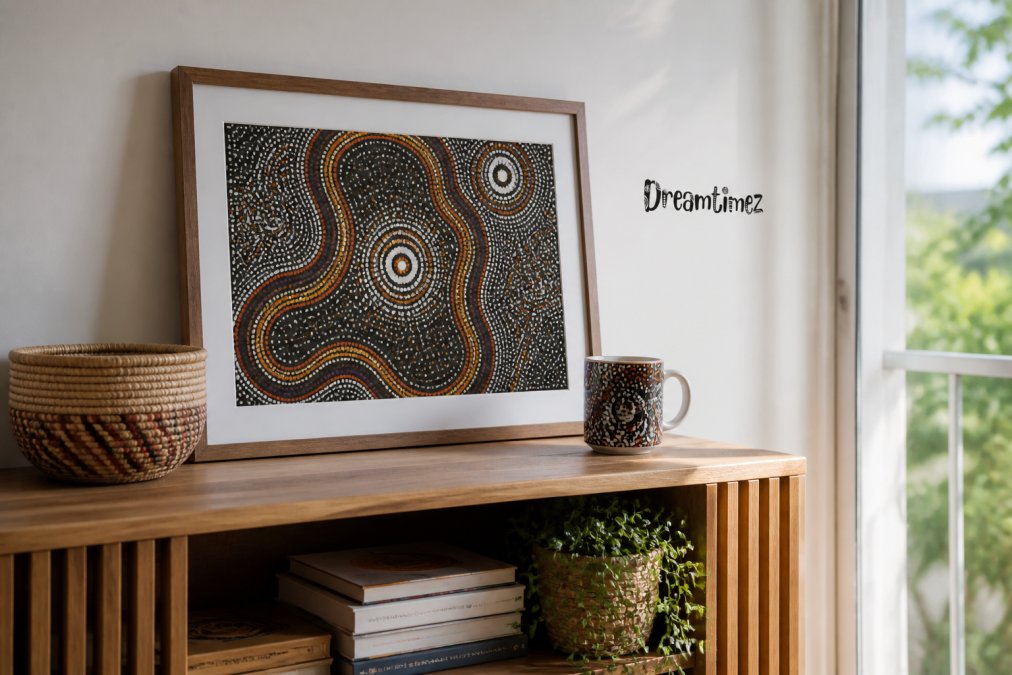
The reason this matters beyond aesthetics is economic: buying licensed Indigenous design moves money directly to artists and their communities, while mass-produced imitations fund a supply chain that never consulted them.
Supporting Indigenous-Led Fashion Businesses
Supporting Indigenous-led businesses means buying from brands where Indigenous people hold ownership and design control, not just inspiration. Ownership divides genuine support from performative allyship.
Several Indigenous-led labels keep design authority in community hands. Clothing The Gaps is an Aboriginal-led social enterprise directing profits toward social change (Q&A with Clothing the Gaps). Haus of Dizzy, founded by Wiradjuri woman Kristy Dickinson, makes bold statement jewellery treating cultural identity as wearable art (About Us). Magpie Goose collaborates directly with artists in remote communities, sharing profits and giving them a national platform.
What they share is a refusal to let the market dictate design: they set the pace, the story and the terms.
Why Indigenous Fashion Is a Global Story Now
Contemporary Indigenous design has moved beyond a niche category, appearing on international runways, in major exhibitions and in the wardrobes of people who have never set foot in the communities behind the work.
That visibility cuts both ways: it creates real income for artists and puts cultural heritage before new audiences, but it also invites imitation, which is why design sovereignty matters more as exposure grows, not less.
Mainstream fashion trends respond to what sold last season; Indigenous fashion responds to what a community has decided to share, and on what terms.
Frequently Asked Questions
What is the difference between Indigenous fashion and mainstream fashion?
Indigenous fashion is built around storytelling, Country, kin and community ownership, with designs licensed from artists who hold the rights to that cultural knowledge. Mainstream fashion follows seasonal trend cycles, mass production and anonymous design teams. In practice, an Indigenous-led piece carries a named artist, a royalty arrangement and a story, while a mainstream equivalent is usually trend-driven and mass-produced with no cultural accountability attached.
How can I ensure the Indigenous fashion or art I buy is authentic?
Look for a named artist or artist collective, a licensing or royalty statement, and a business that identifies as Indigenous-owned or Indigenous-led. Check whether the seller explains where the design came from and who benefits. If a product shows Aboriginal-style motifs with no artist credit, no community link and no transparency about payment, treat that as a warning sign rather than a bargain.
What are the protocols for wearing Indigenous-designed clothing?
Wearing Indigenous-designed clothing is generally welcomed when the piece is licensed and the artist benefits. The main protocols are to buy from legitimate sources, credit the artist when asked about the design, avoid altering sacred or ceremonial imagery, and never treat the work as a generic costume. If you are unsure whether a design carries cultural restrictions, ask the seller or the artist before you wear it publicly.