


Table of Contents
- Why Aboriginal Symbols Still Matter in Modern Design
- How to Identify Authentic Aboriginal Art
- Cultural Protocols for Indigenous Design
- Using Aboriginal Symbols in Authentic Aboriginal Art Home Decor
- Frequently Asked Questions
Last Updated: September 14, 2026
Why Aboriginal Symbols Still Matter in Modern Design
Aboriginal symbols are the visual language of the world's oldest continuous cultures, encoding story, law and Country in marks predating written records. This guide explains what they mean, how to spot the genuine article, and the protocols that keep your design choices respectful. Distinguishing between mere aesthetic ornamentation and profound symbolic meaning in design remains essential for anyone seeking to honor the integrity of these ancient narratives.
How to Identify Authentic Aboriginal Art
Authenticity rests on provenance, not appearance: genuine work carries a named artist, a licensed design and, where relevant, a certificate of authenticity or an Indigenous Art Code dealer agreement.
Three checks separate the real from the reproduction:
- Artist attribution: A named artist, community or art centre, not a generic "Indigenous-style" label.
- Licensing: Designs used under a formal licence or commission, with agreed terms for the artist.
- Documentation: A certificate of authenticity or a dealer registered with the Indigenous Art Code.
The Australia Council for the Arts publishes protocols for working with Aboriginal and Torres Strait Islander artists, worth reading before buying anything "Aboriginal-inspired".
Cultural Protocols for Indigenous Design
Cultural protocols govern who may use a symbol, how, and with whose permission. Some marks are public; others are restricted by gender, ceremony or clan, so ask the artist or art centre rather than assuming.
The practical rules: commission or license rather than copy; credit the artist wherever the work appears; never use a symbol whose story you cannot explain with permission; pay for the work, and keep paying where royalties are agreed; and leave restricted imagery alone.
IP Australia notes that Indigenous Cultural and Intellectual Property sits largely outside standard copyright, which is exactly why formal licensing matters.
Using Aboriginal Symbols in Authentic Aboriginal Art Home Decor
Genuine aboriginal symbols belong in a home like any meaningful object: chosen deliberately, credited openly, and placed where the story can be seen.
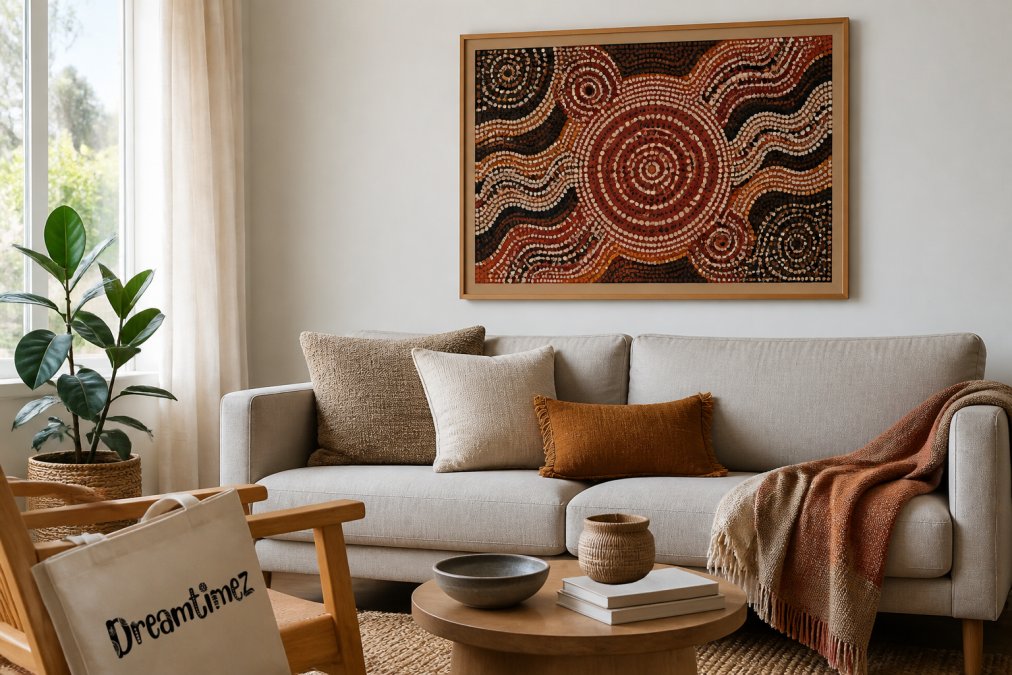
For a neutral interior, start with one statement piece and build around it:
| Room | Piece | Why it works |
|---|---|---|
| Living room | Framed canvas or print | Anchors the wall without dominating |
| Dining | Table linen or serveware | Everyday use, constant visibility |
| Bedroom | Cushion or throw | Softens a neutral palette |
Dreamtimez Australia licenses designs directly from Indigenous artists and pays ongoing royalties on every sale, so the story travels with the purchase.
Frequently Asked Questions
Is it okay to use Aboriginal symbols in modern design?
Using Aboriginal symbols in modern design is only appropriate when the work is created or licensed by Aboriginal artists. Symbols carry specific meanings tied to Country, Dreaming stories and cultural identity that vary between communities. Using them without permission strips away that meaning and can cause harm. The safest approach is to buy from brands that license artwork directly from Indigenous artists, so the symbols stay connected to their source and the artist is paid for their work.
How can I tell if Aboriginal art is authentic?
Authentic Aboriginal art usually comes with clear information about the artist, their community and the licence or agreement behind the product. Look for a named artist, a story or meaning attached to the design, and a statement about royalties or payment. If a product shows generic dot patterns with no artist credit, treat it with caution. Asking the seller directly who created the design and how they were paid is the simplest way to check authenticity.
Why does Indigenous art matter in contemporary design?
Indigenous art matters because it is a living record of culture, not just decoration. It carries oral history, ancestral stories and knowledge passed down through generations. When designers use it respectfully, it keeps that cultural continuity visible in everyday life and supports Aboriginal and Torres Strait Islander artists economically. It also gives non-Indigenous audiences a genuine connection to cultural identity and Country, rather than a diluted or copied version of it.
Choosing symbols with meaning takes more care than choosing a colour scheme, and that care is the whole point. Dreamtimez Australia licenses authentic Indigenous Aboriginal artwork directly from artists, pays ongoing royalties on every sale, and contributes part proceeds from every Fly Net Hat to the Royal Flying Doctor Service. Get started with Dreamtimez Australia and bring a real story into your home.