


Table of Contents
- Indigenous Art vs Western Art: A Direct Comparison for Your Home
- Authentic Aboriginal Art Home Decor: Choosing Pieces That Fit Your Space
- Indigenous Art Cultural Protocols: Buying and Styling With Respect
- Styling Aboriginal Art in Modern Interiors: Minimalist and Maximalist Approaches
- Where Dreamtimez Australia Fits
- Frequently Asked Questions
Last Updated: September 10, 2026
Indigenous Art vs Western Art: A Direct Comparison for Your Home
Indigenous art and Western art solve the same design problem in opposite ways: Western art decorates a wall, while Indigenous art carries Country, story and law into the room. At Dreamtimez Australia, we license designs directly from Indigenous artists.
The practical difference comes down to narrative density, colour logic, spatial weight, and what the piece asks of the viewer.
| Dimension | Indigenous Art | Western Art |
|---|---|---|
| Primary purpose | Encodes story, Country and kinship | Expresses individual vision or decorates |
| Visual structure | Layered symbolism, dot painting, rarrk, cross-hatching | Perspective, figure, abstraction, composition |
| Colour logic | Earth ochres, and colours tied to Country | Trend-driven palettes, often seasonal |
| Viewer's role | Learning the narrative over time | Immediate aesthetic response |
| Provenance | Artist, community and licence matter | Gallery or print house attribution |
| Best placement | Focal point with breathing room | Flexible; works in clusters |
Western art rewards a quick look; Indigenous visual language rewards a slow one, a distinction that decides where each piece belongs.
Authentic Aboriginal Art Home Decor: Choosing Pieces That Fit Your Space
Authentic aboriginal art home decor starts with one rule: buy from a source that can name the artist, the community, and the licence behind the design.
A common mistake is buying for the colour palette first: the piece matches the couch, then sits awkwardly because the narrative does not suit the room. Instead, choose the room's job, then the story, then the size, then the frame last.
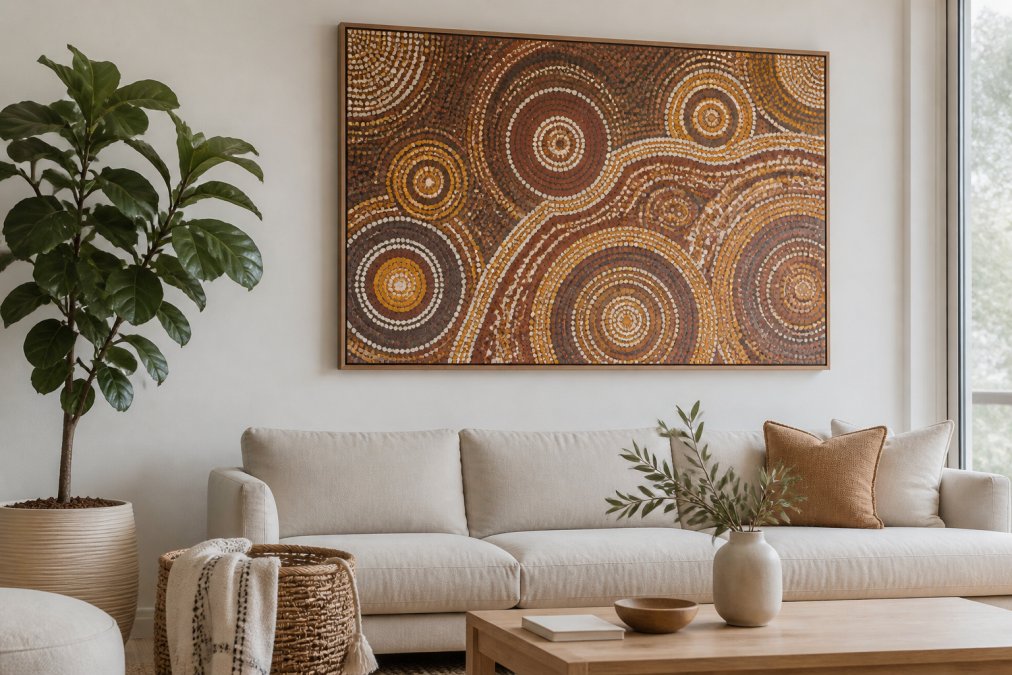
For a minimalist interior, one strong piece beats four small ones. In a maximalist room, Indigenous work holds its own against pattern and texture, but needs clear space or the symbolism gets lost.
How do I know a piece is authentic?
Authenticity is verifiable provenance: a named artist, a licensing agreement, and confirmed royalty arrangements. Ask the seller directly, and expect the answer in writing.
Indigenous Art Cultural Protocols: Buying and Styling With Respect
Indigenous art cultural protocols govern which designs can be reproduced, by whom, and for what purpose. Some imagery is restricted by gender, ceremony or Country, and no interior trend overrides that (aiatsis.gov.au).
Respectful buying means confirming the artist is named on the product page or certificate, that royalties are paid to the artist, that the design has no cultural restrictions, and that you never reproduce, crop or recolour the artwork yourself.
Styling with respect also means placement: a piece tied to a specific Country does not belong in a bathroom or garage. Treat it as a significant object, not a colour swatch.
Styling Aboriginal Art in Modern Interiors: Minimalist and Maximalist Approaches
Minimalist interiors suit Indigenous art better than most people expect: a neutral room lets dot painting and cross-hatching do the work, and the piece becomes the focal point without competition.
Maximalist rooms need a different tactic: group Indigenous work with plain textures, raw timber, undyed linen and unglazed ceramics so the pattern stays legible, and never stack it against busy patterned textiles.
Lighting matters more than most guides admit: direct sunlight fades natural pigments and degrades canvas. Hang away from full western sun, use diffused or angled lighting, keep pieces out of damp rooms, and ask for UV-filtering glazing when framing.
Where Dreamtimez Australia Fits
Dreamtimez Australia licenses designs directly from Indigenous artists and pays ongoing royalties on every sale, answering the question most buyers actually have: is the artist getting paid? Part proceeds from every Fly Net Hat go to the Royal Flying Doctor Service, and the range covers home, dining, fashion and stationery (flyingdoctor.org.au).
Frequently Asked Questions
What is the difference between Indigenous art and Western art styles?
Indigenous art carries narrative, symbolism and connection to Country, often using dot painting, rarrk cross-hatching and X-ray techniques. Western art traditions tend to prioritise individual expression, abstraction or realism. In styling terms, an Indigenous piece usually works as a statement with meaning, while a Western print often serves as a colour or texture filler. Knowing which role you need makes the choice easier.
How do I incorporate authentic Aboriginal art into a modern home?
Start with one focal point, such as a large canvas on a main wall, and keep surrounding decor quiet so the work reads clearly. Choose pieces whose palette echoes your existing scheme, and avoid hanging art in direct sunlight. Buying through a licensed supplier, where artists receive ongoing royalties, keeps the piece both authentic and ethically sourced.
Does Aboriginal art suit minimalist Western interior design?
It suits it well when you treat the artwork as the single statement piece. A minimalist room with neutral walls, timber or stone textures and limited clutter lets the narrative and colour of the work carry the space. Mixing several busy patterns at once is where the two visual languages start competing, so keep the rest of the room restrained.
Choosing between Indigenous art and Western art for home styling is not really a style decision. It is a decision about what you want the room to do: look good, or carry meaning. Dreamtimez Australia sits on the second side of that line, with artwork licensed directly from Indigenous artists, royalties paid on every sale, and part proceeds from every Fly Net Hat supporting the Royal Flying Doctor Service. Browse the collection and hang a story, not just a print.